2026-10-02
Content
Two suppliers quote the same 420 square metre rooftop terrace. Both describe their boards as green composite decking, both offer a fifteen year warranty, and the two prices sit within four percent of one another. The decision rarely comes down to price. It comes down to whether the recycled content, the binder chemistry and the end of life route can be put in writing.
That is the short answer. Green composite decking earns the description through three measurable things: reclaimed plastic, reclaimed cellulose filler, and a service life long enough to avoid repeated replacement. The rest, including colour names and brochure language, is secondary. What follows covers the checks that matter, the tolerances that show up on site, and the questions that keep an environmental claim from becoming a procurement risk.
Wood plastic composite is a blend of polyolefin plastic, most often polyethylene, and a cellulose filler such as wood flour or rice husk. Both streams are recovered materials. The plastic is regrind from factory scrap or post consumer packaging, and the filler is sawmill dust or agricultural residue that would otherwise be burned or landfilled. No slow growth hardwood is harvested, and no annual oiling or solvent based staining is needed while the deck is in service.
Set that against a tropical hardwood deck of the same size. Hardwood needs refinishing every one to two years, with the associated solvent, brush and labour costs, and it has to be replaced sooner when boards rot at the fixings. A WPC board of good density stays in service for fifteen to twenty five years with soap and water cleaning, and PE based profiles can be reground into new profiles at the end of that life. If you want the material basics before reading test reports, this overview of what WPC decking is explains how the boards are produced.
Read the page on what WPC decking is to see how the ingredients become a finished profile.
Recycled content in WPC boards commonly ranges from 50% to 95% of the plastic fraction, but the number alone says little. Post consumer material carries a stronger story than factory regrind, and a written declaration with a third party test report carries more weight than either. Ask which stream the supplier uses, and whether the figure covers the whole profile or only the core.
Wood flour from furniture and flooring mills is the standard filler. Rice husk is used where it is abundant and brings slightly different moisture behaviour and colour. Either way, the filler must be dried and treated before compounding. Moisture above 2% at the extrusion stage is the most common cause of internal voids and early surface cracking.
A hollow profile uses roughly 30% to 40% less material per square metre of surface than a solid board of comparable thickness, which is the largest single lever on embodied material in a decking project. The trade off is span. Hollow boards generally need joists at 300 mm to 350 mm centres, while solid boards can span 400 mm.
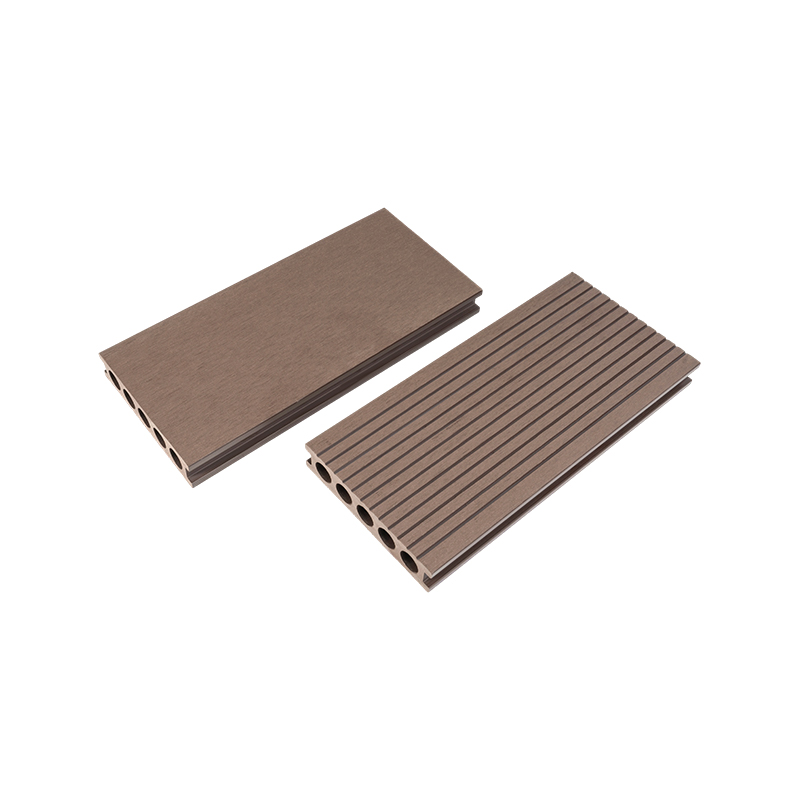
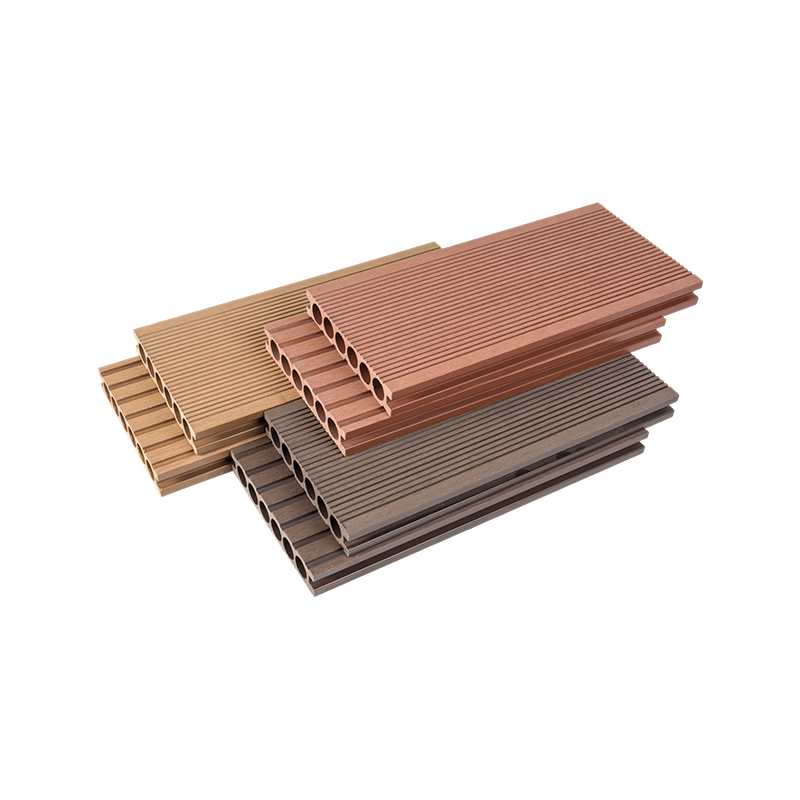 Hollow Composite Decking Outdoor Flooring Waterproof TileHollow Composite Decking Outdoor Flooring Waterproof Tile is an outdoor decking material based on wood-plastic composite (WPC). Made from over 40% recycled wood fiber ...View Product →
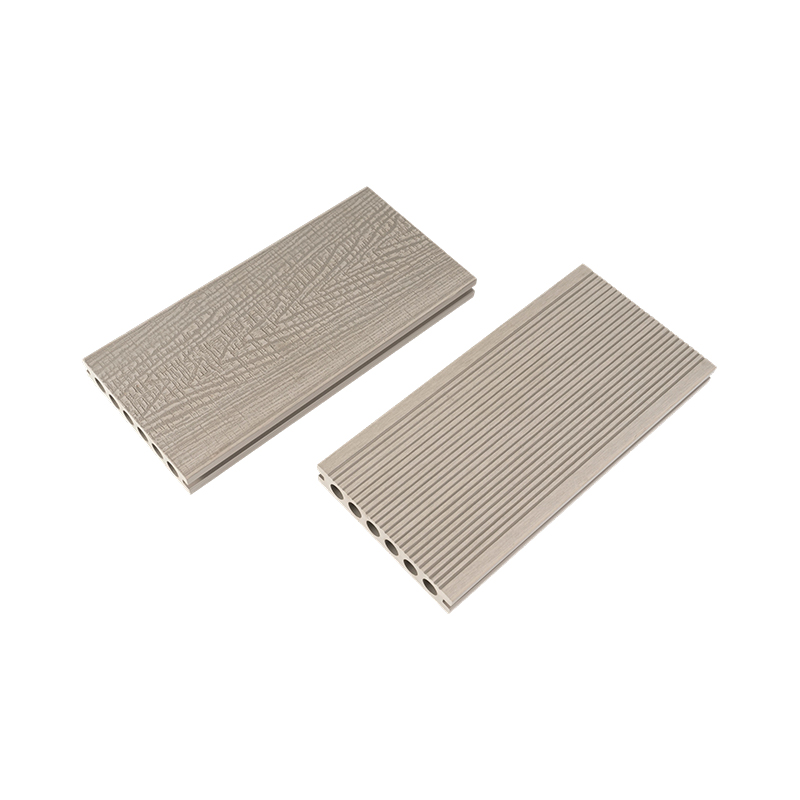
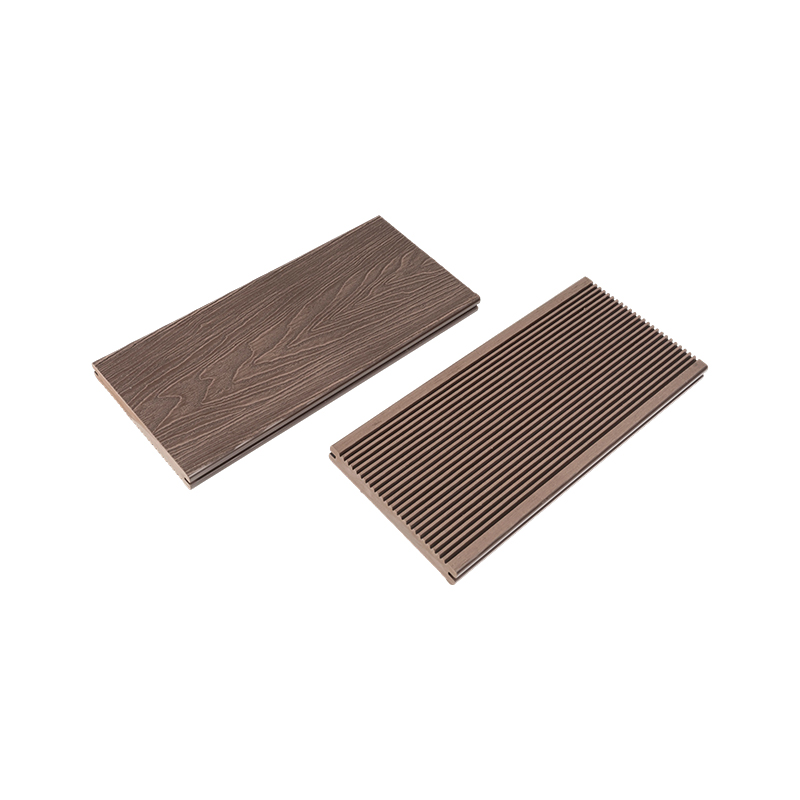
Co-extrusion bonds a thin polymer cap over the core in the same pass. The cap carries the pigment and takes the wear, so the board holds its colour without repainting and resists staining better than a bare core. A 3D embossed surface is pressed with heated rollers and adds grain depth without adding a coating. A classic brushed surface is a single material finish: cheaper per square metre, but more reliant on ventilation and regular cleaning.
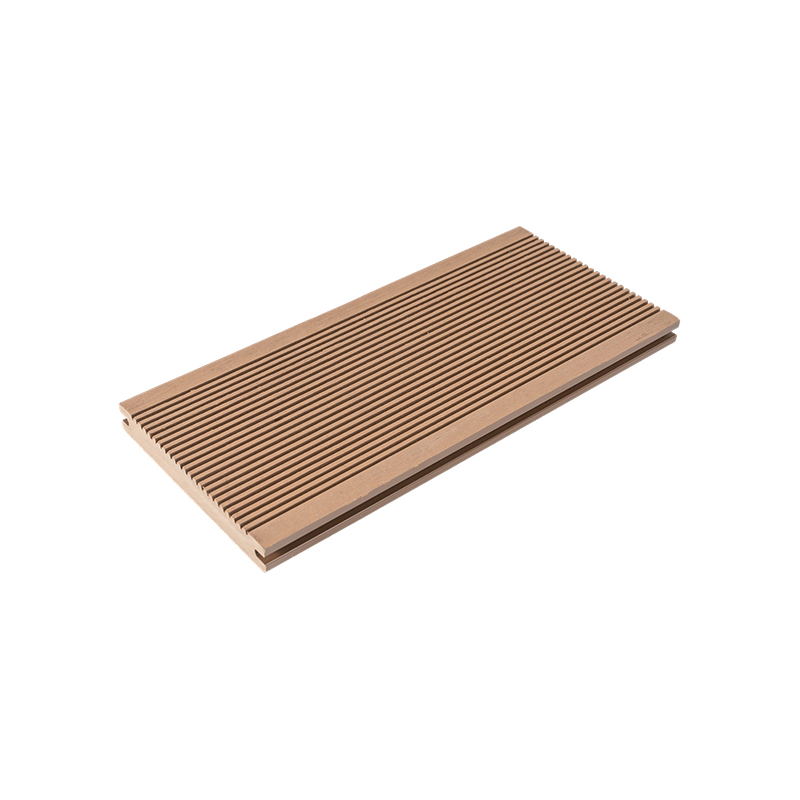
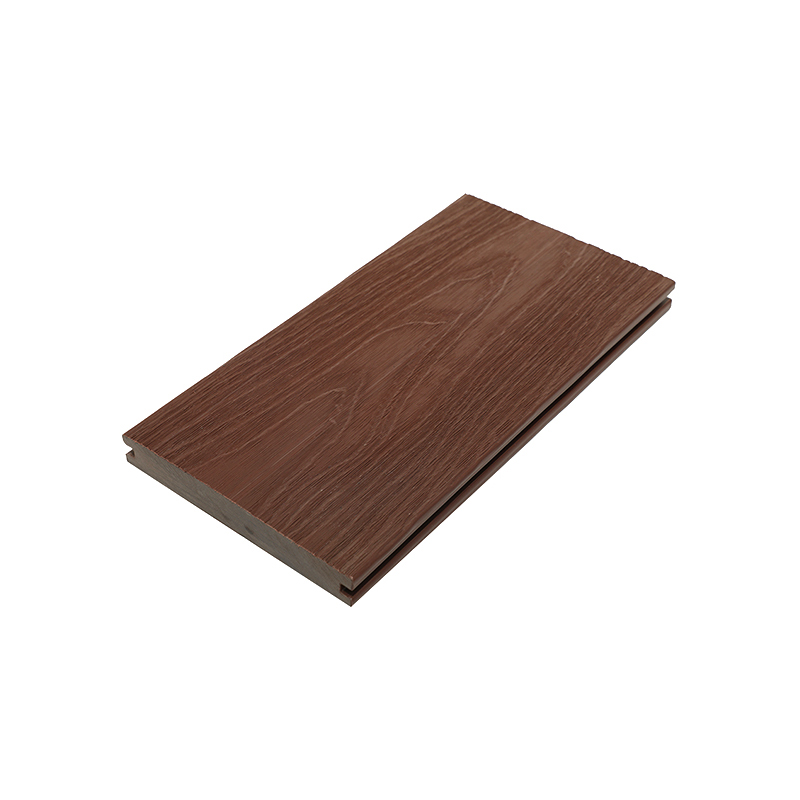 Solid Co-extrusion Decking WPC Wood Plastic Composite FlooringSolid Co-extrusion Decking is a wood-plastic composite (WPC) flooring produced using co-extrusion technology. The planks measure 150mm x 20mm, with single-plank length...View Product →
Every item in the table below can be supplied as a document or a measured value. Ask for them with the quotation, not after the first container arrives.
| Property | Document or value to request | Consequence if it is missing |
|---|---|---|
| Recycled plastic content | Written percentage and source, plus a third party test report | The environmental claim cannot be carried into your project file |
| Moisture content at dispatch | Oven dry result, 2% or lower | Swelling, weak screw hold, joints closing in hot weather |
| Water absorption | 24 hour immersion result, target below 2% | Staining and surface bloom after a wet season |
| Dimensional tolerance | Batch sample within plus or minus 0.5 mm on width and thickness | Uneven gaps and visible stepping between boards |
| Flexural strength | Report in MPa for dry and wet conditions | Deflection under foot traffic and failed site inspection |
| Slip resistance | Wet test result, friction above 0.42 or an R11 rating | Safety incidents on ramps, steps and pool edges |
| Colour stability | Accelerated UV test with shift below 3 Delta E units | Fading complaints within the first two summers |
| Thermal movement | Expansion per linear metre and the specified end gap | Buckling on long runs in direct sun |
| End of life route | Take back, regrind or disposal guidance | The circular claim falls apart at final documentation |
A deck performs as designed only when the substructure is right. Most fading, mould and movement complaints trace back to framing decisions rather than to the board itself.
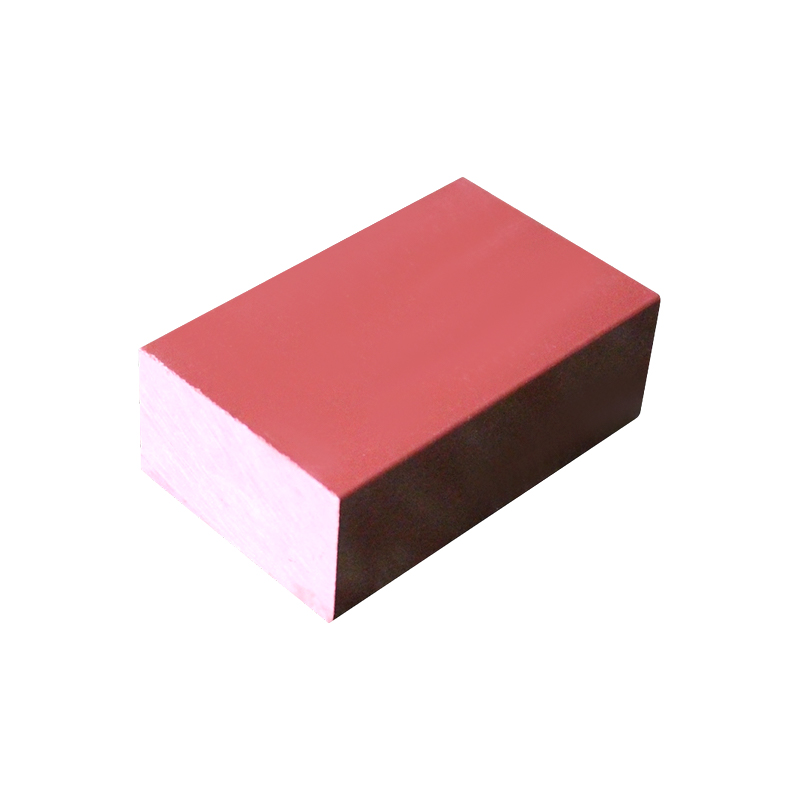 Joist WPC Keel For Flooring Wall PanelJoistWPCKeelForFlooringWallPanel is a joist system made of wood-plastic composite (WPC) material, designed to support prefabricated panels for floors, walls, and ceili...View Product →
Comparing two offers on equal terms is easier when the declaration, the report and a physical sample arrive together. Buyers who need all three can send a request through the contact page, which also routes technical questions to the people who write the profile specifications.
The greenest specification is the one still in place in twenty years, so match the profile to the way the space is used.
| Application | Suggested profile | What to confirm |
|---|---|---|
| Rooftop terrace or balcony | Hollow co-extrusion with cap | Wet slip resistance, support height, weight limits |
| Garden path and lawn edge | Classic or embossed, solid or hollow | Drainage fall, edge restraint, weed control layer |
| Pool surround | Capped co-extrusion in a light colour | Chlorine exposure, surface temperature, gap width |
| Commercial plaza | Solid co-extrusion | Flexural strength, cleaning regime, replacement policy |
| Fencing and wall cladding | Capped wall panel, aluminium framed fence | Wind load fixing spacing, movement on long runs |
Green composite decking is a material decision before it is a marketing one. Reclaimed plastic, a properly dried cellulose filler, a capped or embossed surface and a ventilated substructure do most of the work. Ask for the numbers, check them against the tolerances in this guide, and let the documentation decide which quotation is genuinely the greener one.



 English
 Français
 Español
 Deutsch