2026-03-27
Content
WPC decking — wood-plastic composite decking — offers a compelling combination of advantages that traditional wood decking and pure plastic decking cannot individually match: the natural appearance and warm texture of real wood, the durability and rot-resistance of a plastic-based material, dramatically reduced maintenance requirements, excellent weather resistance, slip safety, and a more sustainable use of resources. These combined properties explain why WPC decking has grown from a specialist product into one of the most widely specified outdoor flooring materials globally, receiving strong demand from both residential and commercial customers.
The most fundamental advantage of WPC decking is its ability to deliver the visual character of natural wood while systematically eliminating the physical failure modes that make traditional timber decking a maintenance-intensive and relatively short-lived product.
The maintenance burden of traditional wood decking is one of the most commonly cited reasons consumers switch to WPC. Timber decks require annual or biennial oiling, staining, or painting to maintain both appearance and structural protection — a time-consuming task that, if neglected, allows rapid accelerated deterioration. WPC decking reduces this maintenance cycle to a fraction of the timber equivalent.
A WPC deck typically requires no oiling, staining, sealing, or painting at any point in its service life. Routine maintenance is limited to periodic washing with water and mild detergent — a task that takes minutes rather than hours and requires no specialist materials or skills. This maintenance-free characteristic translates directly into lower lifetime cost of ownership, even when the higher upfront cost of WPC boards versus pressure-treated timber is factored in.
Over a typical 25-year deck lifespan, the cumulative cost of oiling, staining, and occasional board replacement for a timber deck can easily equal or exceed the initial installation cost of the deck itself. WPC decking eliminates virtually all of this ongoing expenditure, making its total cost of ownership significantly lower than timber in most scenarios despite the higher initial material cost.
WPC decking is engineered for the full range of outdoor weather conditions — from prolonged sun exposure and UV radiation to freeze-thaw cycling, heavy rain, and coastal salt-laden air. Quality WPC decking boards incorporate UV stabilizers in the polymer matrix that prevent the photodegradation that causes materials to bleach, become brittle, and lose surface integrity over time.
| Weather Challenge | Traditional Wood Response | WPC Decking Response |
|---|---|---|
| UV / prolonged sunlight | Greys, bleaches, surface checks form | UV stabilizers prevent bleaching; minimal color change |
| Heavy rain / waterlogging | Water absorption leads to swelling, rot | <1% moisture absorption; drains freely |
| Freeze-thaw cycling | Ice formation in cracks accelerates splitting | Low moisture content prevents ice damage |
| Coastal salt air | Salt accelerates degradation of finishes | Salt has no chemical effect on WPC composite |
| High temperature / heat exposure | Drying accelerates cracking and paint failure | Thermal expansion manageable with correct board spacing |
WPC decking is specifically engineered to replicate the visual character of natural wood decking while delivering greater consistency than natural timber, which varies unpredictably in grain pattern, knot frequency, and color between boards and even within a single board.
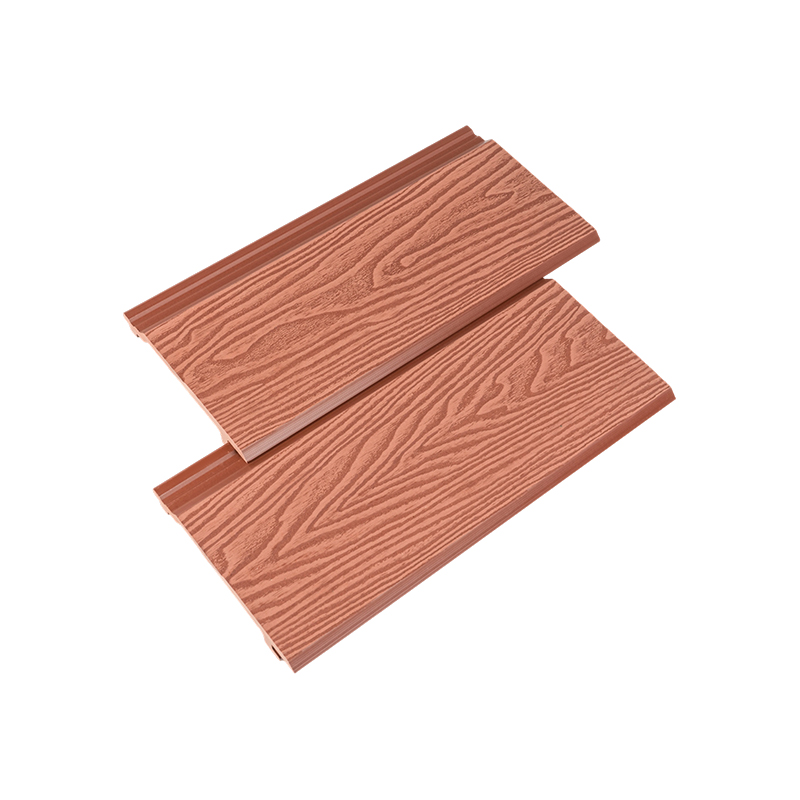
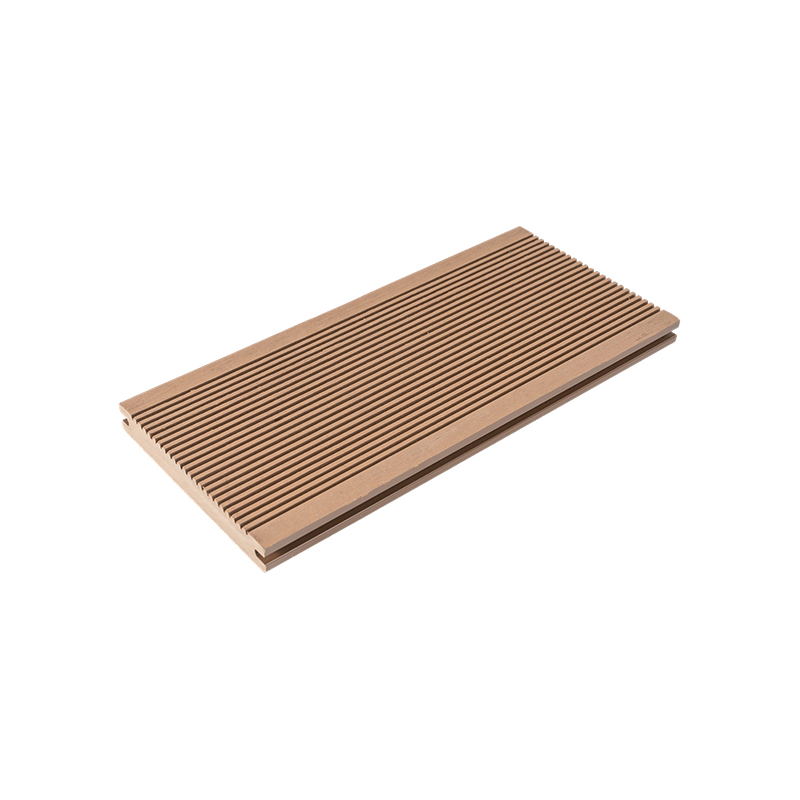
The surface of WPC boards is typically available in two textures that reference natural wood: grooved profiles that replicate the saw-cut or brushed texture of natural hardwood planks, and flat smooth profiles for a cleaner, more contemporary aesthetic. Both surface types are produced with wood-grain embossing that replicates the visual depth and shadow patterns of real wood grain — a significant aesthetic advance over the flat, plasticky appearance of earlier composite board generations.
WPC decking is available in a range of colors — typically spanning natural tan, mid-brown, dark brown, grey, and charcoal — that replicate the appearance of different wood species from light pine to dark hardwood. Unlike natural wood, where color varies board by board, WPC boards within a production batch maintain consistent color, simplifying the visual planning of a deck installation and eliminating the need for careful board selection and arrangement that a timber installation requires.
Outdoor decking safety is a critical specification requirement, particularly around swimming pools, on boat docks, and in areas regularly exposed to rain — environments where wet surface slip hazard is a genuine risk. WPC decking addresses safety through two mechanisms.
The grooved surface profile that characterizes most WPC decking products serves a functional as well as aesthetic purpose — the longitudinal grooves provide drainage channels that remove standing water from the walking surface after rain or splashing, significantly improving wet-surface traction compared to a flat smooth surface. Quality WPC decking products are independently tested to international slip resistance standards such as EN 13893 and typically achieve ratings suitable for outdoor barefoot use areas including swimming pool surrounds and marine applications.
Timber decking boards warp, bow, and cup as they respond to changing moisture content — a structural instability that causes uneven board surfaces, raised fixing screws, and gaps that develop between boards over time. WPC boards' low moisture absorption dramatically reduces this movement, maintaining a flatter, more level deck surface throughout seasonal weather changes and preserving the integrity of the board-to-joist connections that hold the deck structure together.
The combination of rot resistance, UV stability, moisture resistance, and structural stability gives quality WPC decking a significantly longer practical service life than comparable timber decking in most outdoor environments.
Pressure-treated pine and softwood timber decking — the most common entry-level deck material — typically requires board replacement within 10 to 15 years even with regular maintenance in temperate climates, and as few as 5 to 8 years in tropical, coastal, or high-humidity environments. Premium hardwood decking (e.g., teak or ipe) can last longer but at significantly higher initial material cost.
Quality WPC decking products are typically warranted by manufacturers for 15 to 25 years — a service life period that accounts for the expected level of UV fading, surface wear, and structural performance retention. Many installed WPC decks perform well beyond their warranty period when correctly installed and given minimal routine maintenance.
WPC decking offers genuine environmental advantages that are increasingly relevant to specifiers, contractors, and end users concerned about sustainable material choices.
| Performance Criterion | WPC Decking | Traditional Softwood Timber | Premium Hardwood Timber |
|---|---|---|---|
| Rot resistance | Excellent | Poor–Moderate (treated) | Good–Excellent |
| Maintenance frequency | Very low — wash only | High — annual oiling/staining | Moderate — periodic oiling |
| Splinter risk | None | High (aged boards) | Low–Moderate |
| Moisture absorption | <1% | 10–20% | 5–12% |
| Typical service life | 15–25 years+ | 10–15 years | 15–25 years |
| Slip resistance (wet) | Good–Excellent (grooved) | Moderate (new); Poor (aged) | Good (grooved) |
| Initial material cost | Medium–High | Low | High–Very High |
| Total lifecycle cost | Low (minimal maintenance) | High (frequent maintenance) | Medium (periodic maintenance) |



 English
 Français
 Español
 Deutsch