2026-04-03
Content
A WPC door is a door made from wood-plastic composite (WPC) — a new type of eco-friendly engineered material that combines wood fiber or wood flour with thermoplastic polymers such as PVC, polyethylene, or polypropylene to create a panel that has the visual warmth and workability of wood with the moisture resistance and dimensional stability of plastic. WPC doors achieve zero formaldehyde emissions, making them significantly safer for indoor air quality than traditional MDF (medium-density fiberboard) doors. They are waterproof, dimensionally stable, termite-resistant, and soundproof — properties that have made them a leading choice for residential, commercial, healthcare, and institutional door applications worldwide.
WPC stands for Wood-Plastic Composite — a category of engineered materials produced by combining wood-based fiber (wood flour, sawdust, rice husks, or bamboo powder) with thermoplastic polymers and various additives through a high-temperature extrusion or compression molding process. The resulting composite material inherits beneficial properties from both its component materials while mitigating the weaknesses of each.
A typical WPC formulation for door panels contains approximately 50–70% wood fiber content and 30–50% polymer content by weight, with small percentages of additives including UV stabilizers, colorants, coupling agents, lubricants, and foaming agents. The specific ratio and formulation are adjusted by manufacturers to achieve target performance profiles for different applications — denser formulations for structural door cores, foamed formulations for lighter door panel applications.
The wood fiber provides structural rigidity, workability with standard woodworking tools, and the surface texture that allows realistic wood-grain finishes to be applied. The polymer matrix binds the fiber together, provides moisture resistance, prevents biological decay, and gives the material its dimensional stability under changing humidity conditions.
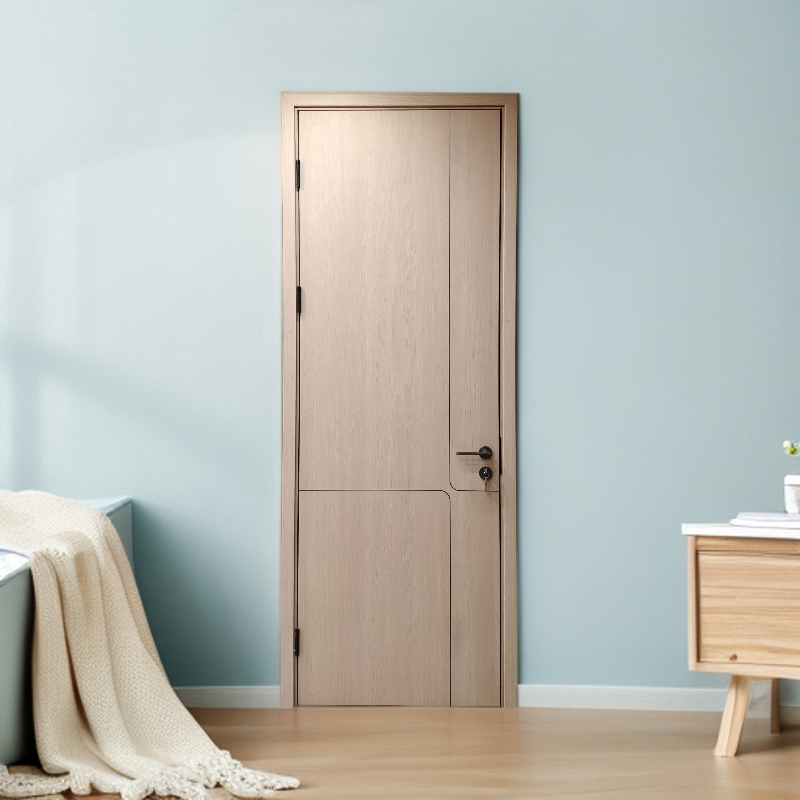
WPC doors are typically constructed as complete door systems — the door panel, door frame, and architrave can all be manufactured from WPC materials, creating a fully integrated waterproof and formaldehyde-free door assembly.
The door panel is produced by extrusion or compression molding of WPC material into the required thickness — standard door panel thicknesses are typically 35mm, 40mm, and 45mm. The panel surface can be finished in multiple ways: a factory-applied PVC film lamination with realistic woodgrain or solid color printing, a melamine paper overlay, or a paintable surface for site-applied decoration. The core may be solid WPC material for maximum acoustic performance and impact resistance, or a cellular/foamed WPC core for lighter weight with reduced material cost.
The door frame — comprising the head and two jamb sections that fit the door opening — is also manufactured in WPC for installations requiring complete moisture-resistant, formaldehyde-free performance. WPC door frames are extruded with pre-formed profiles that accept standard hinges, strike plates, and door stops without the additional cutting and fitting that timber frames require. The matching material of panel and frame ensures consistent appearance, thermal expansion behavior, and guaranteed compatibility throughout the assembly's service life.
WPC doors offer a range of performance advantages over the traditional door materials they increasingly replace — solid wood, MDF, and hollow-core timber construction.
| Performance Criterion | WPC Door | Solid Wood Door | MDF Door |
|---|---|---|---|
| Formaldehyde emissions | Zero | Low (natural wood) | Moderate to high (adhesive binders) |
| Waterproof performance | Excellent — fully waterproof | Poor — absorbs moisture, swells | Very poor — swells and delaminates when wet |
| Dimensional stability | Excellent — no warping or swelling | Poor — warps with humidity changes | Moderate — warps in high humidity |
| Termite and insect resistance | Excellent — polymer inedible to insects | Poor — highly susceptible | Moderate — less attractive but not immune |
| Sound insulation | Good — dense composite mass | Good (solid); Poor (hollow core) | Good (solid panel) |
| Maintenance requirements | Very low — wipe clean only | Moderate — periodic repainting | Low–Moderate |
| Indoor air quality impact | Excellent — zero emissions | Good | Poor — ongoing formaldehyde off-gassing |
| Cost | Medium | Medium–High | Low |
One of the most medically significant advantages of WPC doors over conventional MDF and particleboard doors is the complete absence of formaldehyde emissions. This distinction is particularly important in interior door applications where occupants are in close, prolonged proximity to the door material throughout their daily lives.
Traditional MDF doors use urea-formaldehyde (UF) or melamine-formaldehyde (MF) resin binders to hold the wood fiber matrix together. These resins off-gas formaldehyde — a volatile organic compound classified as a Group 1 human carcinogen by the International Agency for Research on Cancer (IARC) — into the indoor environment for months to years after installation. In poorly ventilated spaces, formaldehyde concentration from MDF furniture and doors can exceed the 0.1 ppm WHO indoor air quality guideline within months of installation.
WPC doors contain no formaldehyde-based binders — the wood fiber is held together by the thermoplastic polymer matrix rather than chemical adhesives. The result is a door material that contributes zero formaldehyde to the indoor environment, making WPC doors the appropriate specification for environments where air quality standards are paramount: children's bedrooms, hospitals, schools, elderly care facilities, and any space housing occupants with respiratory sensitivities.
WPC doors are the preferred choice for bathrooms, kitchens, laundry rooms, and any other high-humidity interior environment where conventional timber or MDF doors consistently fail within a few years.
The failure of conventional interior doors in wet environments follows a predictable sequence: moisture absorption causes the door panel to swell at its base and edges, paint or laminate finish to delaminate, and the door to bind in its frame — requiring forced operation that damages hinges and the frame. In MDF doors, moisture absorption also causes the board to permanently swell and soften, losing its structural integrity and screw-holding capacity.
WPC doors absorb less than 1% moisture by weight even after prolonged immersion, compared to moisture absorption rates of 10–15% for MDF and 8–20% for softwood timber under equivalent conditions. This near-zero moisture absorption means WPC door panels do not swell, warp, or lose their dimension in bathroom environments — maintaining consistent fit within the frame and consistent operation throughout their service life regardless of bathroom humidity fluctuations.
WPC doors are used across a wide range of building types and room applications where their combination of moisture resistance, zero formaldehyde, durability, and acoustic performance makes them superior to traditional door materials.
WPC doors are designed for ease of installation and offer extensive customization options that allow them to be specified for virtually any interior design context.



 English
 Français
 Español
 Deutsch