2026-09-24
Content
At a furniture testing bench, a heavy steel plate pressed down on a composite deck board until the surface began to dent. That test was measuring compression strength, not the bending resistance that most decking span tables describe. Compression strength determines how well a board resists concentrated pressure without crushing, indenting, or losing its shape. It matters under a large planter, a barbecue grill, or a crowd standing in one area. The practical conclusion is that most wood plastic composite decking, especially solid or co-extruded profiles, can handle normal residential vertical loads when the joists follow the manufacturer span table. The greater risk is local indentation, not sudden failure.
Compression strength is the maximum stress a material can withstand when squeezed between two surfaces. During a compression test, a flat platen pushes on a sample while the machine records the force at which the sample yields or cracks. For composite decking, this value is usually reported in megapascals or pounds per square inch. A higher value means the board can better resist a point load or a small bearing plate without creating a permanent depression.
Do not confuse compression strength with bending stiffness. Bending stiffness controls how much a board flexes between joists, while compression strength controls local crushing at the surface or at the bearing point. If a heavy outdoor kitchen sits on the deck, the cabinet feet apply a concentrated load. If the board is soft, the feet may leave dimples. If the substructure is correct, most WPC boards will not collapse, but softer formulations may show visible marks.
The chart above compares representative compressive strength values among common decking materials. PVC decking usually sits at the lower end because the polymer is softer and contains no wood fiber reinforcement. Standard WPC mixes wood fiber with polyolefin, which improves compression resistance. Capped WPC adds a protective shell that carries part of the concentrated load and reduces surface indentation. Pressure-treated pine, at least in the direction parallel to the grain, can be stronger in compression than uncapped composite. The conclusion is not to compare composite with wood as if a single number decided the winner; the right question is how the material behaves under your actual load and living conditions.
WPC manufacturers control compression performance mostly through density and formulation. A board with higher density has more material in the same volume, so it usually has higher compressive strength. The type and proportion of wood fiber, mineral filler, coupling agent, and plastic all play a role. If a board is foam-filled to save weight, the outer shell may be strong while the core is less able to resist crushing.
The line chart shows the general trend between density and compressive strength in a typical WPC series. As the density rises from about 0.55 to 0.95 grams per cubic centimeter, the compressive strength climbs from around 18 MPa to near 50 MPa. This happens because fewer voids in the core improve the transfer of load through the material. However, density alone does not predict structural behavior. A high-density board with poor coupling between wood and plastic can still fail at a fastener. A co-extruded board can also combine a lower-density core with a dense outer layer to balance weight and surface strength. For buyers, the useful takeaway is to compare density, compression values, and span tables together.
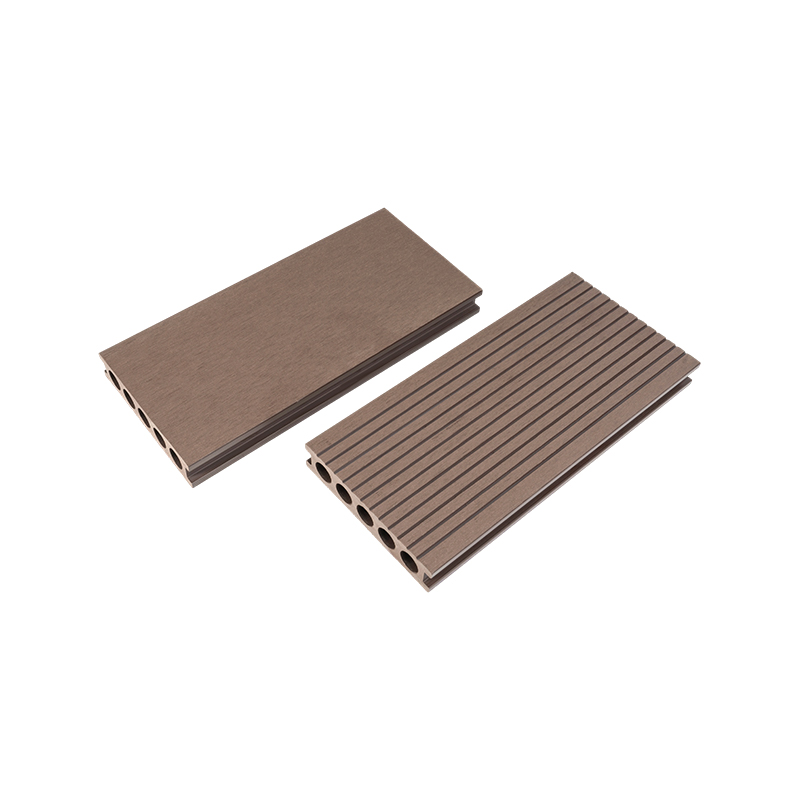
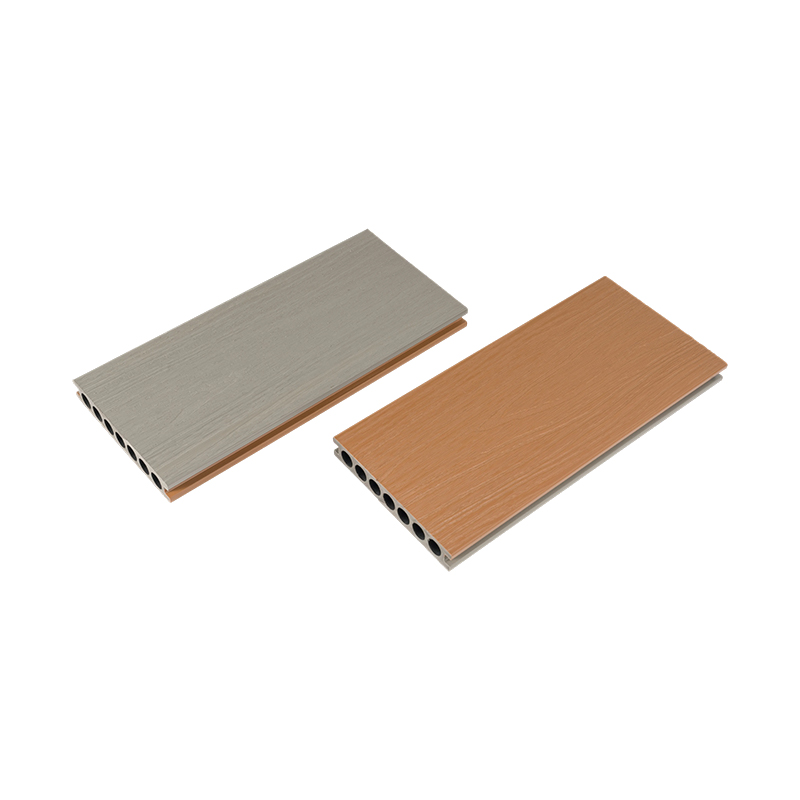
In the factory, the same WPC recipe can be shaped into different profiles. Hollow boards contain longitudinal voids that reduce weight and material use. Solid boards have no such voids and are denser per meter, giving more material to resist a concentrated load. Co-extruded solid boards add a protective cap around a solid core, which helps prevent surface indentation and degradation from UV exposure.
The bar chart shows an effective concentrated load comparison for boards of the same width and thickness, all installed at 400 millimeter joist spacing. The hollow board carries a lower concentrated load before visible indentation appears, while the solid board performs noticeably better. The co-extruded solid board has the highest resistance because its cap distributes the pressure over the surface while the solid core supports the load. This is why manufacturers recommend hollow boards mainly for residential decks with moderate furniture and pedestrian traffic. For commercial projects, public spaces, or areas with heavy objects, a solid or co-extruded solid board is a safer choice.
One way to understand the difference is to compare the solid co-extruded profile with a standard hollow profile from the same production line. A manufacturer that offers both profile families can usually provide load tables and representative test reports for each one.
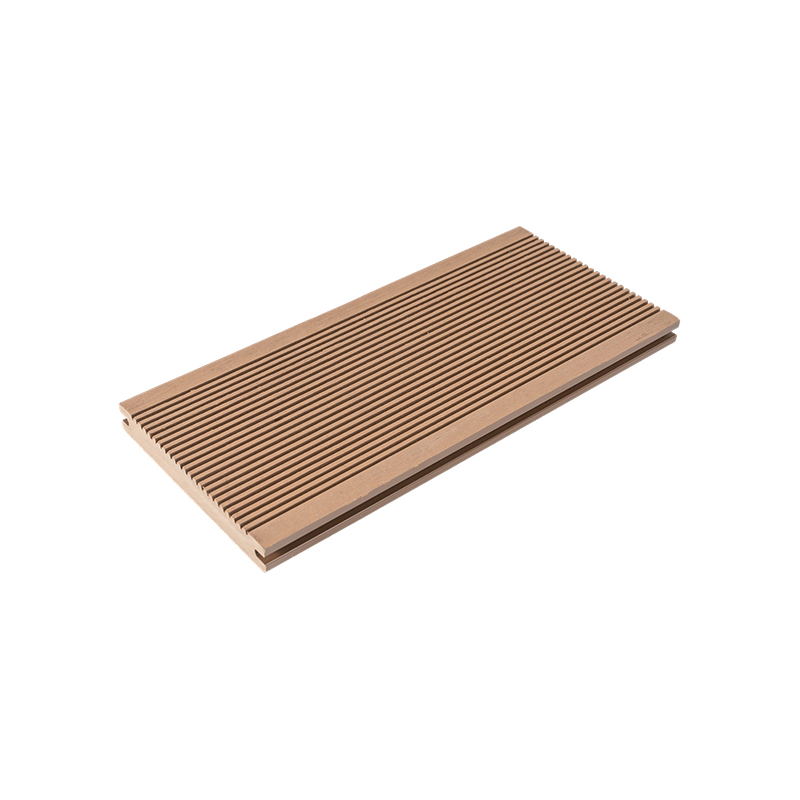
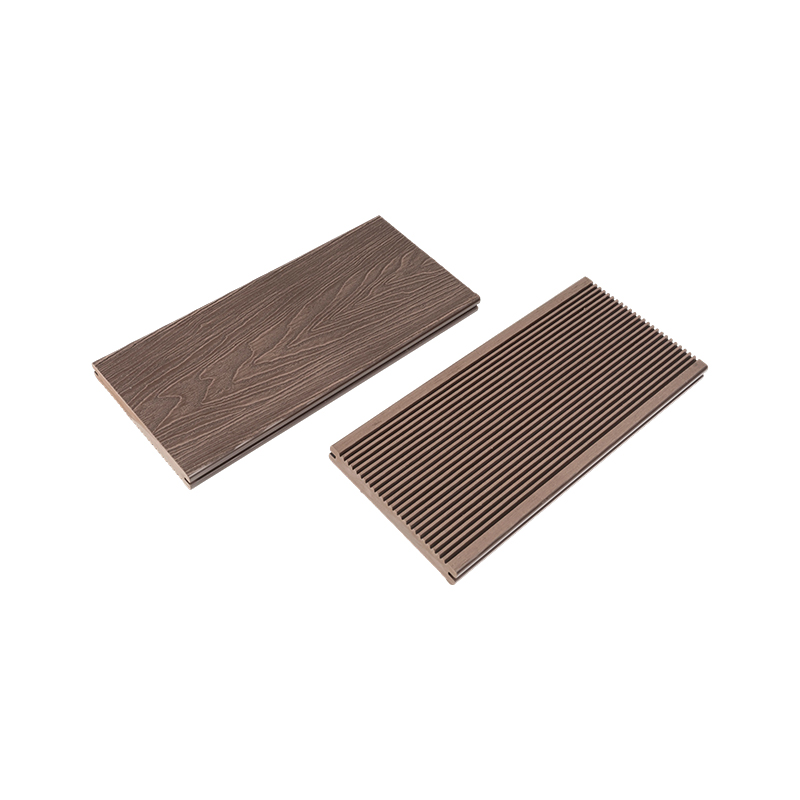
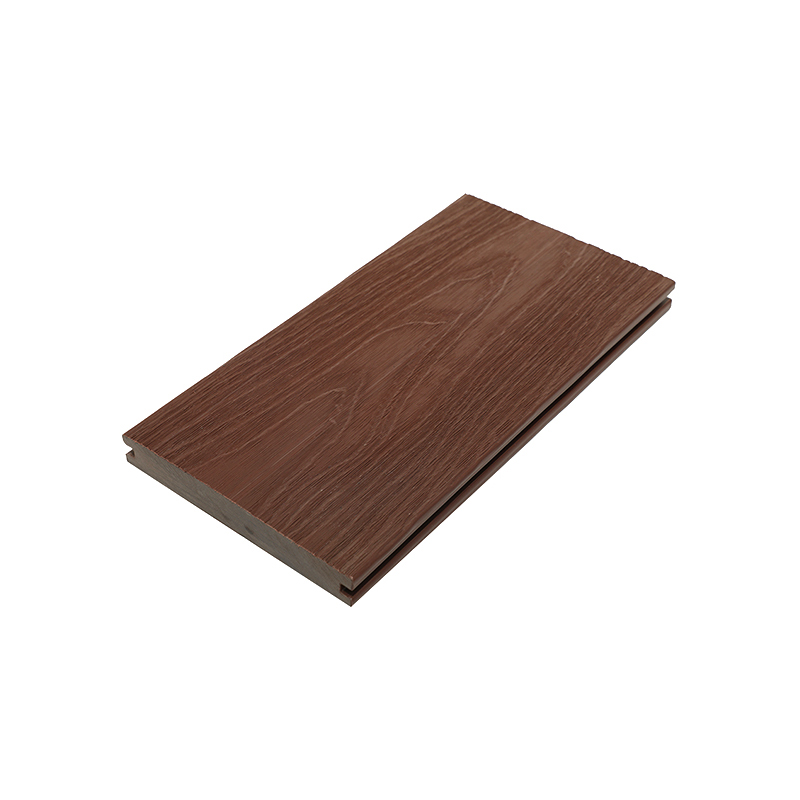 Solid Co-extruded WPC Decking Board 150x20mmThis co-extruded composite plank combines a protective HDPE surface with a solid core, offering high bending strength and moisture resistance. Its realistic wood grain and low-maintenance finish make it a worthwhile option when comparing solid and hollow profiles for demanding deck projects.View Product →
Compression strength does not work in isolation. The substructure decides how much bending load reaches the board and how well the load spreads through the joists. If joists are spaced too far apart, even a high-compression board can flex excessively. As the board deflects, the top surface goes into compression and the bottom surface goes into tension. If the compression surface is weak, the board may show micro-cracks near the point of highest stress.
A practical example: at 300 millimeter joist spacing, a typical composite deck board can support a higher concentrated load than the same board at 400 millimeter spacing. This is why the manufacturer installation guide matters as much as the material datasheet. When the framing is properly spaced and the board is adequately supported, compression strength becomes less likely to limit the design.
| Board profile | Maximum joist spacing | Typical application |
|---|---|---|
| Hollow WPC | 300 mm | Light residential use |
| Solid WPC | 400 mm | Residential decks and terraces |
| Co-extruded solid WPC | 400 mm | High-traffic decks and commercial spaces |
The support system itself is not only about the deck boards; the joist profile must also have enough bearing area and a stable cross-section to transfer load and keep the finished floor aligned.
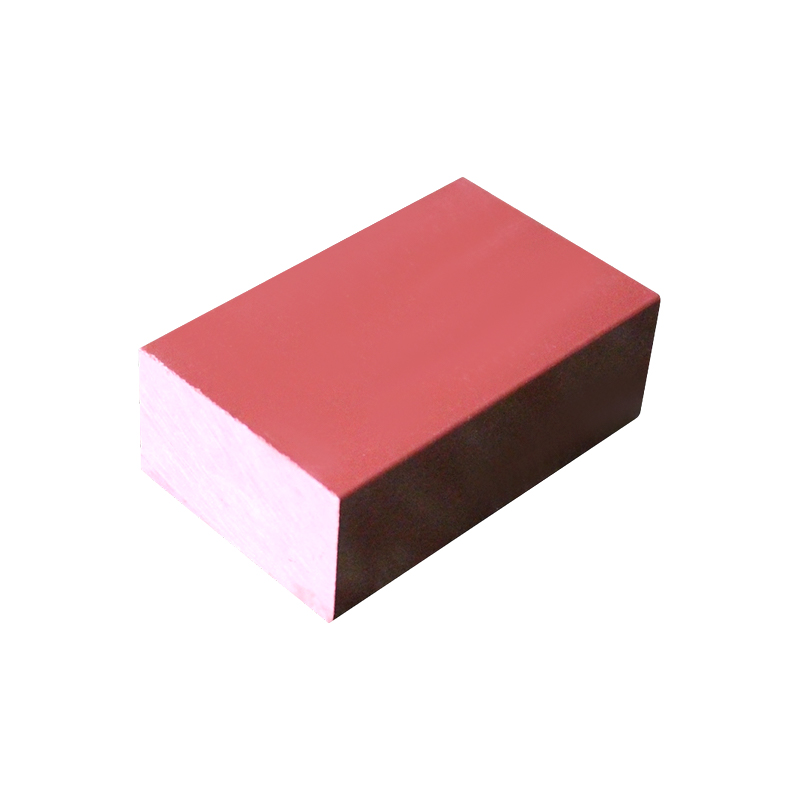 WPC Joist Keel System for Floor and Wall PanelsA wood-plastic composite joist with a 40x25mm cross-section, available in standard and steel-reinforced versions. It provides stable support for panels and helps distribute loads in decking substructures. Its corrosion resistance and 30-35mm recommended spacing are practical for ensuring a level, durable finished floor.View Product →
Buyers often ask whether composite decking is as strong as wood. The simplest answer is that WPC can be strong enough when the profile and framing are chosen correctly. Wood is good at resisting bending and compression in a simple test, but it loses strength when moisture causes splitting, warping, or decay. Composite decking trades a little raw strength for stability, longer visual life, and lower maintenance. A balanced material selection weighs compression, bending, slip resistance, and moisture resistance together.
The radar chart compares solid WPC, pressure-treated wood, and PVC decking across five practical attributes. Solid WPC scores high on moisture resistance and longevity, with good compression and bending scores. Pressure-treated wood scores high on raw compression and bending, but much lower on moisture resistance and longevity. PVC decking is strong in moisture resistance but weak in compression, bending, and slip resistance. The chart shows why a material that wins one test can still be wrong for a full project. For most outdoor decks, a well-made WPC board offers the most balanced combination in real-world service.
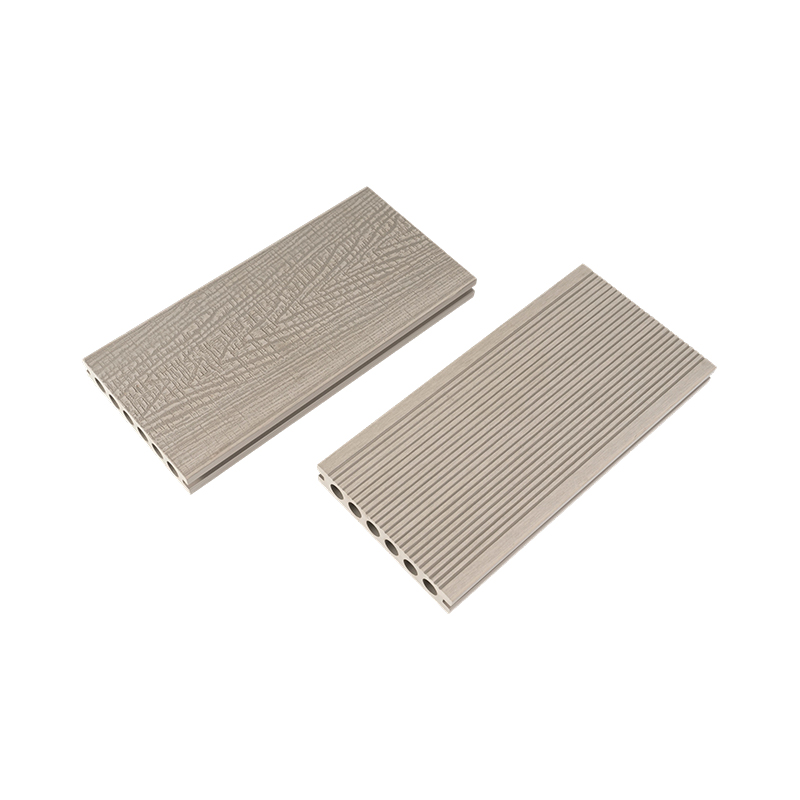
If the load is modest and the client wants a lighter, more economical board, a hollow 3D embossed profile can be a sensible choice. It reduces material use while still providing a wood-like texture and adequate compression performance for light residential traffic.
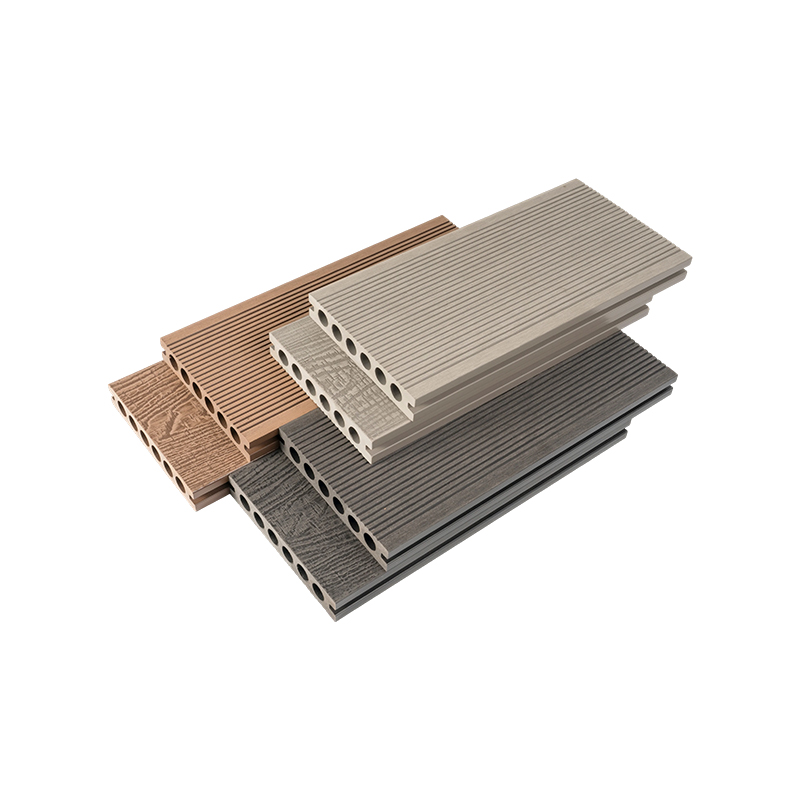 Hollow 3D Embossed WPC Outdoor DeckingThis lightweight hollow-profile composite deck features a 3D embossed wood grain and slip-resistant grooves. It balances material efficiency with adequate compression strength for moderate residential use, while its waterproof, UV-resistant WPC formulation suits wet or sunny outdoor environments.View Product →
When you evaluate composite decking compression strength, do not stop at a single number. Ask the supplier for compression test reports and span tables that match the joist spacing in your project. Compare hollow, solid, and co-extruded profiles against the actual traffic and furniture load. Check whether the manufacturer recommends special joist spacing for hidden fastener systems. Confirm that the warranty covers structural performance, not just color fading. If a supplier cannot provide load data or a clear installation guide, treat that as a red flag.
Start by reading the basics of WPC decking, then ask a manufacturer for the compression and bending data for the exact profile you are considering. A transparent supplier will share those numbers before you place an order.
Compression strength is one part of the decking quality picture. A well-designed composite deck fails only rarely from pure crushing; surface indentation, joint movement, and excessive deflection are more likely under normal use. When you choose a board that is dense enough for the load, properly supported by joists, and installed with the right hardware, it will outperform wood in the ways that matter most to long-term outdoor service. Look for a manufacturer that publishes compression values, span tables, and installation guidance, because that level of transparency is the strongest guarantee of structural performance. For more guidance, contact the manufacturer directly with your project details.



 English
 Français
 Español
 Deutsch